
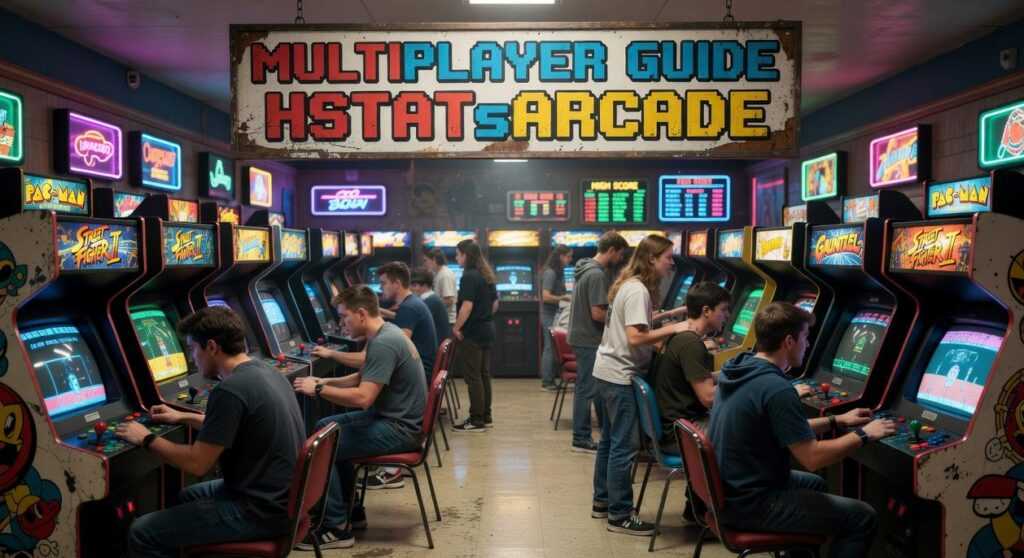
I’ve spent years watching players get stuck at the same skill level in arcade games.
You’re probably here because you keep losing to better players or can’t break into the top scores no matter how much you practice. I get it. Button mashing only gets you so far.
Here’s what separates casual players from the ones dominating leaderboards: they understand patterns. They know when to attack and when to hold back. And they’ve mastered techniques most people never learn.
I put together this multiplayer guide hstatsarcade after analyzing what actually works in competitive matches and high-score runs. Not the flashy stuff that looks cool. The tactics that win games.
This guide breaks down the core strategies you need for both multiplayer battles and arcade mode. I’ll show you how to read your opponents, recognize scoring patterns, and execute moves that actually matter.
We’ve pulled from decades of arcade knowledge to make this practical. Real techniques that work whether you’re fighting another player or chasing a personal best.
You’ll learn the universal principles that apply across most arcade games, plus specific tactics for climbing leaderboards and winning matches.
No filler about gaming history. Just the strategies that will get you winning today.
The Foundation: Mastering the Universal Arcade Mindset
You’ve probably heard people talk about “getting good” at arcade games.
But what does that actually mean?
Most players think it’s about faster reflexes. Mashing buttons quicker than the next person. And sure, speed helps. But it’s not the foundation.
I’m going to break down what separates players who burn through credits from those who make every quarter count.
Beyond Button Mashing
Here’s what nobody tells you about arcade games.
Every input matters. Every single one.
When you’re button mashing, you’re basically hoping something connects. You’re throwing out attacks and movements without thinking about why you’re doing it.
That’s not how you win.
What you need is deliberate execution. It sounds fancy but it’s simple. Before you press a button, you know what you want to happen. You’re not reacting blindly. You’re making choices.
Think about it like typing. When you first learned, you hunted for each key. Now your fingers know where to go. That’s deliberate execution. Your brain decides what to do and your hands follow through with precision.
Some people say this approach is too slow for arcade games. They argue that overthinking gets you killed.
But here’s the thing. Deliberate doesn’t mean slow. It means intentional. Once you train yourself to execute with purpose, you’ll move just as fast. You’ll just waste fewer moves on actions that don’t help you.
Pattern Recognition is Key
Every arcade game speaks a language.
Enemy movements aren’t random. Level layouts follow rules. Scoring opportunities appear in predictable spots.
Your job? Learn to read what the game is telling you.
When that boss winds up for an attack, there’s usually a tell. A flash. A sound. A specific animation. Once you spot it, you know what’s coming next.
This is where most players give up too early. They play a game twice, lose both times, and move on. But pattern recognition takes repetition. You need to see the same situation enough times that your brain starts connecting the dots.
(It’s like watching a movie for the second time and catching all the foreshadowing you missed.)
The multiplayer guide hstatsarcade community talks about this all the time. Players who dominate leaderboards aren’t necessarily faster. They just know what’s coming.
Resource Management
This one surprises people.
You’re not just managing health bars. You’re managing everything.
Your special meter? That’s a resource. Use it on the wrong enemy and you won’t have it when you need it.
Power-ups? Same deal. Grab that invincibility too early and you’ll wish you’d saved it for the boss.
Even your position on screen matters. Stand in the wrong spot and you’ve got nowhere to dodge. That’s poor resource management.
Strategy games get all the credit for this concept. But arcade games demand it just as much. The difference is you have milliseconds to decide instead of minutes.
Think of your health as currency. Every hit you take costs you. So does every risky move that might get you hit. Is that aggressive play worth the price? Sometimes yes. Sometimes no.
When you start viewing everything as a resource you can spend or save, the game changes. You stop playing reactively and start playing smart.
Competitive Multiplayer: How to Outplay Your Opponents
You load into a match feeling confident.
Then someone absolutely destroys you in the first 30 seconds.
I’ve been there. We all have. You wonder if they’re just better or if there’s something you’re missing.
Here’s what most players don’t get. Winning in competitive multiplayer isn’t about faster reflexes (though that helps). It’s about knowing more than your opponent.
Some people say you should just pick the strongest character or loadout and master it. They argue that tier lists tell you everything you need to know. And sure, playing top tier gives you an advantage. While some players swear by tier lists and the strongest characters to dominate in competitive play, others find their unique strategies and personal flair in games like those featured on Hstatsarcade, proving that mastery can come from creativity as much as from raw power. While many players adhere strictly to tier lists and the strongest characters to gain an edge in competitive play, others find their unique strategies and styles, often showcased on platforms like Hstatsarcade, where creativity can sometimes outshine mere statistical advantage.
But I’ve watched plenty of S-tier players lose to someone using mid-tier options.
Why? Because they didn’t understand the matchup.
Know Your Matchup
Every character has bad matchups. Every loadout has counters.
Let’s say you’re playing a rushdown character against someone with strong zoning tools. If you approach the same way every time, you’ll eat projectiles all day. But if you know their recovery frames and optimal spacing, you can find the gaps.
This works both ways. When you understand what beats you, you also learn what you beat.
The Art of Spacing and Positioning
Here’s where most guides on multiplayer strategy fall short.
They tell you to “control space” without explaining what that actually means. So let me break it down.
Spacing is about staying at the distance where your tools work and theirs don’t. A sniper wants long sightlines. A shotgun user wants tight corners. Simple as that.
Positioning is about cutting off options. If you can force your opponent into a corner or a predictable path, you’ve already won half the battle.
Watch where top players stand during neutral game. They’re not random spots.
Mind Games and Conditioning
This is my favorite part.
You can actually train your opponent during a match without them realizing it. Throw the same move three times in a row. They’ll start expecting it. Then you switch it up and punish their counter.
It’s like poker but faster.
I’ve conditioned players to jump by repeatedly using low attacks. Then I just wait with an anti-air and collect my free hit. Works almost every time in the first few rounds.
The multiplayer guide hstatsarcade community calls this “downloading your opponent.” You’re learning their patterns while feeding them false information about yours.
Adapting in Real-Time
Here’s the hard truth. Mobile Update Hstatsarcade is where I take this idea even further.
Everything I just told you? It stops working the moment your opponent figures out what you’re doing.
Good players adapt. Great players adapt faster.
If your usual approach isn’t working by round two, change it. Immediately. Don’t wait until you’re down 0-2 to try something different.
I watch for three things mid-match. How they respond to pressure. What they do when they get a life lead. How they react after getting hit.
Those tells show me their real strategy.
Some players get aggressive when ahead. Others turtle up. Neither approach is wrong, but once I know which type you are, I can exploit it.
The difference between winning and losing often comes down to who adjusts first. Not who has better execution or the stronger character.
Just who sees the pattern and breaks it before the other person does.
Arcade Mode Mastery: The Science of a High Score

You want to crack the top of the leaderboard.
I see it every time someone walks up to a cabinet at H Stats Arcade. They pump in quarters and mash buttons, hoping muscle memory will carry them to glory.
It won’t.
Some people say high scores are just about natural talent. That you either have the reflexes or you don’t. They’ll tell you memorizing patterns is boring and takes the fun out of gaming.
Here’s what I think about that.
Sure, raw talent helps. But I’ve watched players with average reflexes absolutely dominate because they understood something the “naturals” didn’t. They knew the system.
High scores aren’t accidents. They’re built on understanding exactly how the game rewards you.
Let me show you how to actually do this.
1. Decode the Scoring System First
Open the manual. Check the in-game guide. Figure out what the game actually values.
Does it reward speed runs? Combo chains? Perfect accuracy? Risk-taking moves that could get you killed?
Most players hstatsarcade skip this step. They assume all games work the same way. They don’t.
Street Fighter rewards different actions than Time Crisis. Pac-Man has nothing in common with Dance Dance Revolution’s scoring logic. Just as each classic arcade game has its unique scoring system, players can explore a diverse range of metrics and performance insights through Hstatsarcade Mobile From Hearthstats, enhancing their gaming strategy across different genres. By delving into the unique scoring systems of classic arcade games, players can enhance their performance analysis with Hstatsarcade Mobile From Hearthstats, unlocking a wealth of insights tailored to their gaming style.
Spend 10 minutes learning the rules before you spend 10 hours grinding.
2. Master Point Pressing
This is where you separate casual players from record holders.
Point pressing means knowing EXACTLY when to take risks for extra points. When that dangerous route through enemy fire is worth it. When playing safe and keeping your multiplier alive matters more.
I’ll give you a real example. In most rail shooters, you can chase bonus targets that appear off the main path. Sometimes that’s smart. Other times you’ll miss three guaranteed hits trying to nail one bonus and tank your accuracy rating.
The multiplayer guide hstatsarcade covers this in detail, but here’s the short version. Calculate the actual point difference. If the risky move nets you 500 points but you lose a 3x multiplier worth 2000 points over the next minute? Skip it. For additional context, First Person Online Hstatsarcade covers the related groundwork.
3. Memorize Your Route
If you’re playing anything with set levels, your high score depends on planning.
Beat ’em ups. Rail shooters. Rhythm games. They all have fixed patterns.
Write down enemy spawn points. Note where power-ups appear. Mark every bonus trigger location.
Yes, this takes time. But you know what takes more time? Playing the same game 500 times hoping you’ll randomly stumble into the perfect run.
4. Never Drop Your Combo
This is NON-NEGOTIABLE.
A broken combo chain kills more high-score attempts than anything else. Your multiplier resets. Your momentum dies. Your score growth goes from exponential to linear.
Here’s how to keep it alive:
- Know your combo timer (how long between actions before it breaks)
- Identify filler moves that keep chains going during slow moments
- Position yourself near the next target BEFORE your current combo ends
- Practice the transition points where most people drop chains
In puzzle games, always have your next three moves planned. In fighters, learn which light attacks can bridge gaps between heavy combos.
One dropped combo can cost you 10,000 points in a game where first place is decided by 3,000.
I’ve seen players with perfect execution lose to someone with decent skills and flawless combo discipline. Every single time, the person who maintained their multiplier won.
That’s the science of it.
Quick Tips for Popular Arcade Genres
Want to actually win at the arcade instead of just feeding quarters into machines?
I’m going to give you the shortcuts that work.
Fighting Games: Pick ONE Character
Stop bouncing between the entire roster. You’re just confusing yourself.
Pick one fighter and learn their basic combos. That’s it. Then master one anti-air attack (the move that stops jumping opponents).
This beats 80% of casual players. I’m serious.
The reason? Most people at arcades button mash. When you can execute even three clean combos, you look like a pro. When you can consistently punish their jump-ins, they’ll think you’re unbeatable.
Rhythm Games: Fix Your Timing First
Before you touch a single song, calibrate your timing settings.
Most rhythm games let you adjust audio delay. This accounts for your screen’s response time and the speakers. If your timing is off by even 50 milliseconds, you’ll never hit notes correctly no matter how good you are.
Then practice on easy mode. Learn the patterns at slow speeds. Your muscle memory needs time to develop before you crank up the difficulty.
Light-Gun Shooters: Hunt the Bonus Targets
Don’t just shoot everything that moves.
Special targets (usually glowing or a different color) give you bonus points or extra time. These are WORTH way more than regular enemies. Prioritize them.
And here’s the move that separates amateurs from veterans: reload during quiet moments. Not when ten zombies are charging at you. Wait for the lull, then reload so you’re ready for the next wave.
Shoot ’em Ups: Your Hitbox is Tiny
This changes everything once you know it.
Your character sprite might look huge on screen. But your actual hitbox (the part that takes damage) is usually just a few pixels in the center. Sometimes it’s literally a single dot.
Stop trying to dodge bullets with your whole ship. Focus on threading that tiny hitbox through the gaps. Watch the bullet patterns and move precisely.
You’ll suddenly survive sections that seemed impossible.
For more detailed breakdowns on mastering specific arcade titles, check out the hstatsarcade mobile from hearthstats platform where you can track your progress.
Pro Tip: When you’re learning any new arcade genre, watch the multiplayer guide hstatsarcade players before you spend your credits. Stand behind someone who’s good and study their movements for two minutes. You’ll learn more than you would burning through five dollars trying to figure it out yourself. To elevate your skills in any arcade game, take a moment to observe how players Hstatsarcade navigate challenges, as their strategies can provide invaluable insights that you won’t easily gain from trial and error alone.Players Hstatsarcade To enhance your skills in any new arcade genre, it’s invaluable to observe experienced competitors, as players Hstatsarcade often demonstrate techniques and strategies that can save you both time and money in the long run.Players Hstatsarcade
Practice, Patience, and Victory
You came here because you hit a wall.
That skill ceiling felt impossible to break through. You kept playing the same way and getting the same results.
Now you have a different approach.
This multiplayer guide hstatsarcade gave you the framework to stop guessing and start winning. Whether you’re facing real opponents or chasing leaderboard spots, you know the difference between random button mashing and deliberate strategy.
The path forward is clear. You practice with purpose. You study patterns instead of hoping for luck.
Here’s your next move: Pick one strategy from this guide. Apply it to your favorite arcade game for the next week. Track what changes.
The results will show you what works.
You’re not stuck anymore. You have the tools to climb those leaderboards and dominate in multiplayer matches.
The only question left is which game you’ll conquer first.
 Ask Syrelia Xelvaris how they got into game reviews and strategies and you'll probably get a longer answer than you expected. The short version: Syrelia started doing it, got genuinely hooked, and at some point realized they had accumulated enough hard-won knowledge that it would be a waste not to share it. So they started writing.
What makes Syrelia worth reading is that they skips the obvious stuff. Nobody needs another surface-level take on Game Reviews and Strategies, Community Events and Tournaments, Player Stats and Achievements. What readers actually want is the nuance — the part that only becomes clear after you've made a few mistakes and figured out why. That's the territory Syrelia operates in. The writing is direct, occasionally blunt, and always built around what's actually true rather than what sounds good in an article. They has little patience for filler, which means they's pieces tend to be denser with real information than the average post on the same subject.
Syrelia doesn't write to impress anyone. They writes because they has things to say that they genuinely thinks people should hear. That motivation — basic as it sounds — produces something noticeably different from content written for clicks or word count. Readers pick up on it. The comments on Syrelia's work tend to reflect that.
Ask Syrelia Xelvaris how they got into game reviews and strategies and you'll probably get a longer answer than you expected. The short version: Syrelia started doing it, got genuinely hooked, and at some point realized they had accumulated enough hard-won knowledge that it would be a waste not to share it. So they started writing.
What makes Syrelia worth reading is that they skips the obvious stuff. Nobody needs another surface-level take on Game Reviews and Strategies, Community Events and Tournaments, Player Stats and Achievements. What readers actually want is the nuance — the part that only becomes clear after you've made a few mistakes and figured out why. That's the territory Syrelia operates in. The writing is direct, occasionally blunt, and always built around what's actually true rather than what sounds good in an article. They has little patience for filler, which means they's pieces tend to be denser with real information than the average post on the same subject.
Syrelia doesn't write to impress anyone. They writes because they has things to say that they genuinely thinks people should hear. That motivation — basic as it sounds — produces something noticeably different from content written for clicks or word count. Readers pick up on it. The comments on Syrelia's work tend to reflect that.